Showing posts with label companies. Show all posts

Thursday, 7 March 2013

iOS Ruling in The Enterprise Recent Data Shows, The iPhone in Particular, All at The Expense of Android


Apple’s iOS is consolidating its grip on the enterprise market and taking share from Android, according to customer data from enterprise file sharing and hybrid cloud storage company Egnyte, which offers cloud back-up and storage services for a mix of customers, from large corporates with thousands of seats to SMEs with just a handful.
Of course different enterprises have very different needs and requirements when it comes to mobile devices. Take a look at governments, for instance, and you’d be convinced BlackBerry is still killing it. But as a snapshot of the mobile OSes being favoured by different sized companies, mostly U.S.-based (80 percent of the data, with the other 20 percent pertaining to European businesses), this data is an interesting subset to add to the pile.
The data, shared directly with TechCrunch, covers 100,000 of Egnyte’s paying customers over the last year-and-a-half+, tracking which OS they are using to access its services on mobile devices and also splitting out iPhone and iPad use. The numbers look strong for Apple, with the iPhone especially growing its proportion of users since the second half of 2011 to-date — perhaps helped by the halo effect of iPads arriving in the enterprise and persuading business folk to trade their BlackBerrys for iPhones. Egnyte’s data doesn’t specifically refer to BlackBerrys but does show Apple taking share away from Android.
“Apple seems to have at least temporarily won the hearts and minds of business users with its products accounting for about 70 percent of our traffic,” Egnyte told TechCrunch.
In Q3/Q4 2011, Egnyte’s data shows the following device breakdown — giving iOS a 68 percent majority of Egnyte’s enterprise user-base:

  • iPhone 28%
  • iPad 40%
  • Android 30%  (phones and tablets)
  • other 2%
In 2012, the iPhone grew its proportion, while the iPad’s very sizeable share shrank to below a third — suggesting iPhone usage cannibalised iPad usage to an extent. Overall, though, Apple’s percentage rose to 69 percent:
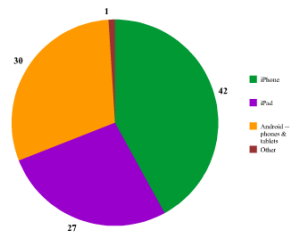
  • iPhone 42%
  • iPad 27%
  • Android 30% (phones and tablets)
  • other 1%
Egnyte has also scraped some early data for Q1 2013, which shows both iPhone and iPad usage rising — this time apparently at the expense of Android phones and tablets, which had previously held a steady share of 30 percent. There is also no sign as yet of a Microsoft enterprise mobile resurgence with its Windows Phone OS (the ‘other’ catch-all category doesn’t yet figure in the 2013 data). Apple holds a whopping, ‘Pacman-shaped’ 78 percent share of the user base as of Q1 2013:
  • iPhone 48%
  • iPad 30%
  • Android 22% (phones and tablets)
Egnyte’s data on enterprise users’ preference for iPhones tallies broadly with data from mobile device management company Good Technology, covered recently by CITEword. Good reported even higher percentages for iOS — with nearly 77 percent of devices activated by its corporate customers in Q4 2012 powered by iOS, up from 71 percent in the fourth quarter of 2011. Good also found Android’s enterprise mobile shared declining, dropping to 22.7 percent in Q4 2012, down from 29 percent in Q4 2011. (It also tracked a 0.5 percent rise for Windows Phone.)
Returning to Egnyte’s data for 2012, almost a fifth (19 percent) of the Android traffic was generated using a Nook tablet — so despite the iPad’s popularity with business users, some enterprises are evidently not immune to the lure of using cheaper tablet hardware.
The company also breaks out Wi-Fi access by device for 2012. It found that 40 percent of iPad sessions occurred over Wi-Fi, while just 31 percent of iPhone sessions did — suggesting the iPhone still prevails as the device of choice in the most mobile situations, ie when users are moving around a lot or aren’t in range of a Wi-Fi network (perhaps because businesses have purchased Wi-Fi only iPads to keep ongoing costs down).
Egnyte speculates that smartphones are fractionally quicker to begin using than tablets, typically sitting within easy reach, so tend to be the device of choice for viewing files on the fly, with users waiting for a more comfortable environment before getting out the tablet to do some editing.  ”Overall, tablet use in the corporate marketplace hasn’t been as high as we would expect, but… we think this may be more due to people’s love affairs with their phones, than for any lack in the capabilities of a tablet,” the company said.
Commenting generally on the data, Egnyte said:
"While initially iPads dominated our use, iPhones have taken over.  2011 use showed the iPad accounting for 40 percent of our usage, in 2012 iPhones are now 42 percent of usage, and Android has remained constant at about 30 percent of use. There are two interesting points here, first, Apple seems to have at least temporarily won the hearts and minds of business users with its products accounting for about 70 percent of our traffic. This is important because it’s a flip-flop from the days of old, where Apple products were rarely seen in the corporate landscape.   It’s also an indication that when BYOD wrested control over what devices consumers used from IT, they overwhelmingly chose an easy to use product that focused on UI and usability, perhaps even at times over depth.
The second interesting point is that while tablets are certainly hot, iPhones are driving most of the traffic. This may be due to the fact that the iPad doesn’t replace a laptop yet as the corporate device of choice, but try and take a business person’s smartphone away from them, and you may not have a hand left.  Smartphones are a must have, and we suspect that since people are already checking email on such a phone while they are working remotely, it’s an extra step to get out and bootup your tablet, so if you have a great phone app that does the same thing, just use it to view your files. Most editing we think still happens on the laptop/desktop.  This ‘on the go’ access is further confirmed by the fact that only 31 percent of iPhone sessions occurred over Wi-Fi, that means over three-quarters of access happens via cellular services." [TechCrunch]
You can follow me on Twitter, add me to your circles on Google+ or Subscribe to me on facebook or YouTube. You can also check my website and blog to keep yourself updated with what is happening in the ever changing world of technology


Tuesday, 15 January 2013

How Hardware Startups Changed The Essence Of CES


It was all bad timing, really. Just ahead of CES 2012, Microsoft announced that year's event would be its last, blaming product schedules that just didn't match up with the annual show. There was no question that the tech giant's absence would be felt the following year, the first time in recent memory the Consumer Electronics Show wasn't kicked off by a Microsoft keynote. It signaled, perhaps, a slight shift away from the days of huge companies dominating the event's headlines -- a phenomenon helped along by the recent attention-grabbing successes of a number of crowdfunded projects, many of which were present at the show.
The move from Bill Gates to Steve Ballmer was one thing, but a CES without Redmond? That was just unheard of, a specter that loomed over the show, even as the CEA happily announced it had sold out the company's floor space in "record time." In the end, of course, Microsoft was still at the show, albeit in a less overt form, by way of third-party machines from Sony, Samsung and the like, and in the form of a cameo by none other than Ballmer himself -- a sort of spiritual baton-passing to the company's keynote successor, Qualcomm. Heck, even the Surface Pro reared its head backstage at the show.


Timing, too, played havoc with this year's mobile announcements, with many manufacturers holding off news until next month's Mobile World Congress in Barcelona. Even RIM opted to forgo the CES press conference, choosing to hold its own event to launch its long-awaited BlackBerry 10 operating system, later this month, and joining in on a larger industry trend of breaking away from the industry's noisiest week.
The relative absence of mobile announcements from the major players in the US market (even Sony, which debuted the Xperia Z, opted not to make the device a centerpiece of its press conference) allowed manufacturers like ZTE and Huawei, largely unknown in the States, to hog the mobile spotlight. Instead, focus from the majors was on the world of Ultra HD, a fact that highlighted one of the biggest concerns with these sorts of shows: product overlap. It's hard not to notice when two of the biggest companies at a show use it as a platform to make a big deal about 65- and 55-inch versions of previously announced 84-inch sets.


But the vacuum of excitement created by the major players contributed to a perfect storm of sorts, mingling with the on-going explosion of crowdfunded projects put into play by the likes of Kickstarter and Indiegogo. The real stars of the show weren't the multinational corporations, but rather the startups that couldn't necessarily afford the astronomical fees required to set up a booth at a show like this. And while this certainly wasn't the first year that crowdfunding has had a presence at the event, there was a sense that 2013 was the year that it truly came into its own, delivering the promise of real, marketable hardware, rather than the sort of vaporware that seems ever-present at CES.
No better was this demonstrated than with the Pebble smartwatch, the Kickstarter phenomenon that seemingly managed to drum up as much excitement as one of those high-end TV sets the majors were hawking. What these projects lack in resource infrastructure, they make up for in adaptability, producing genuinely unique takes on the tech space. It's hard to imagine major corporations experimenting with products as they launch press conferences and ad campaigns designed to pat themselves on the back for adding a few fractions of an inch to a smartphone screen.


Then there were the 3D printers making a big showing compared to the year prior, in which MakerBot unveiled the only high-profile entry in the space. This year, 3D Systems gave the company a run for its money, in the form of the portable Cube (which employees were carrying strapped to their chests while walking the show floor) and the CubeX, with its enormous basketball-sized build platform. Kickstarted company Formlabs, meanwhile, showed off the massively impressive FORM 1, which could bring pro-level 3D printing into the home. The success of such products has contributed to the hardware explosion in their own right, offering up the capability of rapid prototyping in a home environment. Bre Pettis showed us the Square Helper, a credit card iPad accessory that one 3D printer owner is selling -- an example of the "desktop industrial revolution," the MakerBot CEO loves to talk about.
And if CES can be regarded as a sort of testing ground for those far-off conceptual products like the foldable display, crowdfunding has that very thing built-in. If users don't support a product, it doesn't get made.
"Crowdfunding is a natural," SticknFind creator Jimmy Buchheim told us during an interview. "It allows us to bring products to market fast and lets us know whether the products are good or (if we have to) go back to the drawing board."
And certainly there's a lot to be said for the sort of pre-show buzz such campaigns can elicit -- there weren't too many projects that we were more excited to play around with in the lead up to the show than the Oculus Rift.


It will be fascinating to watch how such a shift will affect the show moving ahead. If small companies continue to draw as much or more attention than the big guns by walking the floor in hopes of meeting press members and buyers, it may impact the amount of money they will actually spend to exhibit. The hidden treasures have always been a highlight of shows like CES, but 2013's event seems to have signaled a shift toward a potential future in which they are the focal point.
It's a trend we certainly welcome, both with regards to the slight leveling of the playing field it brings to hardware startups and, perhaps, toward a push for creative thinking amongst the larger companies moving ahead. Hopefully the CEA will expand its effort to embrace these small companies, as well. If the big manufacturers continue to commit to launching products on their own terms, at their own events, crowdfunded companies and their ilk may well prove to be the future of CES. [Engadget]

You can follow me on Twitter, add me to your circles on Google+ or Subscribe to me on FaceBook or YouTube. You can also check my Website and Blog to keep yourself updated with what is happening in the ever changing world of technology